
 11 November 2025
Managing Soil Salinity in Irrigated Fields: Practical Steps for North Indian Farmers
🌾 Why Soil Salinity Is Becoming a Hidden Threat
If your crop looks healthy at planting but turns yellow or stunted midway, your soil might be telling you something — it’s becoming saline.
Across Agra, Bareilly, Kanpur, Farrukhabad, and Haryana’s irrigated belts, soil salinity is silently reducing productivity year after year. Salts accumulate due to over-irrigation, poor drainage, and high evaporation, gradually making the soil hard, compact, and unresponsive to fertilizers.
At Soil Doctor, we’ve analyzed thousands of soil samples from North India, and in many cases, the problem wasn’t lack of nutrients — it was excess salts.
🧪 What Is Soil Salinity?
Soil salinity refers to the build-up of soluble salts (mainly sodium, calcium, magnesium, chloride, and sulfate) in the soil’s upper layer.
These salts come from:
- Irrigation with poor-quality water (high EC or sodium)
- Overuse of fertilizers without soil testing
- Poor drainage in flat or heavy clay soils
- High evaporation under intense sunlight
When salts accumulate, they interfere with root growth, reduce water uptake, and block nutrient absorption — leading to lower yield even when fertilizers are applied.
📉 Signs of Soil Salinity in the Field
Farmers can often detect salinity by observing these early indicators:
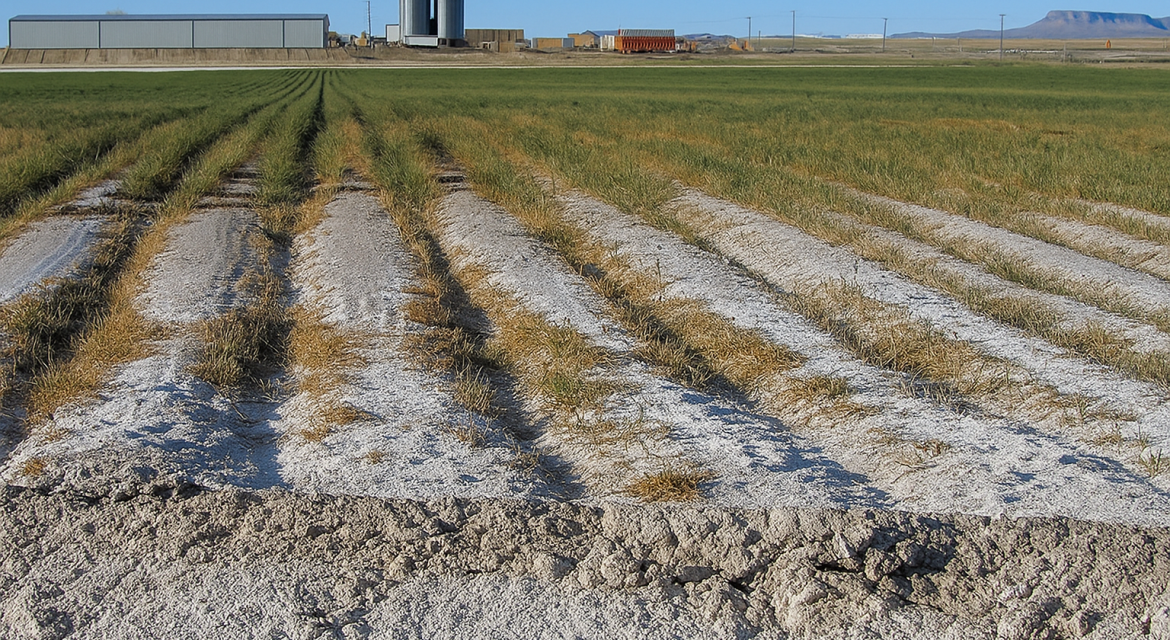
- White or grayish salt crust on the soil surface
- Patchy or stunted crop growth
- Wilting despite regular irrigation
- Hard, compact top layer after drying
- Poor seed germination or uneven emergence
💡 Pro Tip: If you see white patches after water dries, get your soil and irrigation water tested immediately.
🧭 How Salinity Affects North Indian Farmers
According to data from ICAR and state agriculture universities:
- Nearly 2.5 million hectares in North India are affected by salinity and sodicity.
- Wheat, potato, mustard, and sugarcane yields can drop up to 30–40% under moderate salinity.
- EC (Electrical Conductivity) levels above 4 dS/m indicate critical salt stress for most crops.
Salinity isn’t just a soil issue — it’s a profitability issue.
🌿 Step-by-Step: Practical Ways to Manage Soil Salinity
1️⃣ Test Soil and Irrigation Water Regularly
Testing is the first step toward control.
- Conduct soil and water tests at least once a year before sowing.
- Look for key indicators: EC (salinity), pH, SAR (Sodium Absorption Ratio), RSC (Residual Sodium Carbonate).
- Avoid irrigation water with EC above 1.5 dS/m for sensitive crops.
🧪 Visit your nearest Soil Doctor Clinic for accurate testing and expert advice.
2️⃣ Improve Drainage and Avoid Waterlogging
Poor drainage is the biggest contributor to salt build-up.
- Create gentle field slopes (0.1–0.2%) for water movement.
- Install field drains or soak pits in low-lying areas.
- Use raised beds or broad bed-furrow planting for vegetables and wheat.
💧 The goal: prevent standing water from evaporating and leaving salts behind.
3️⃣ Apply Gypsum to Correct Sodicity
In sodic soils (high sodium), gypsum (calcium sulfate) helps replace sodium ions with calcium.
- Apply 1–2 tonnes/acre gypsum based on soil test recommendations.
- Mix it into the top 15 cm of soil before planting.
- Combine with organic matter (like compost or pressmud) for better results.
🧱 Gypsum helps break soil hardness and restore structure.
4️⃣ Leach Excess Salts with Fresh Water
Where good-quality water is available:
- After harvesting, flood the field with water to dissolve and push salts below root zone.
- Repeat 2–3 light irrigations rather than one heavy one — this improves leaching efficiency.
- Ensure proper outlet for drainage to carry salts away.
🚫 Don’t attempt leaching in fields with poor drainage — it can worsen the issue.
5️⃣ Use Organic Matter to Rebuild Soil Health
Organic matter binds salts, improves soil structure, and enhances microbial activity.
- Add compost, farmyard manure, crop residues, or biochar regularly.
- Grow green manure crops like dhaincha or sunhemp before main cropping.
- Use Zytonic-M or bio-fertilizers with organic carbon to revive soil life.
🌱 Remember: living soil resists salinity better.
6️⃣ Choose Salt-Tolerant Crops and Varieties
If your field consistently tests high in salts, select salt-tolerant crops:
- Cereals: Barley, oats, pearl millet
- Pulses: Lentil, chickpea
- Oilseeds: Mustard
- Forage: Sorghum, berseem
- Vegetables: Beetroot, spinach
Consult Soil Doctor agronomists for crop-specific EC thresholds and fertilizer management.
7️⃣ Optimize Irrigation Scheduling
- Avoid shallow, frequent irrigations — they evaporate quickly and leave salts behind.
- Adopt drip or sprinkler systems where possible to reduce evaporation loss.
- Irrigate during cooler hours (early morning or evening).
- Mix fresh water with saline water (if available) to dilute salts before use.
💧 Efficient water management = lower salt accumulation.
8️⃣ Monitor Soil Health Over Time
Salinity control isn’t a one-time activity — it’s ongoing management.
- Retest your soil every 6–12 months.
- Maintain a record of EC, pH, and sodium levels.
- Track how gypsum, organic matter, or new irrigation practices affect results.
📲 All Soil Doctor Clinics maintain digital soil health cards with year-wise tracking.
🌍 Real Impact: How Farmers Are Reclaiming Saline Soils
Case Study – Mainpuri District, U.P.
Ramesh Yadav’s wheat yields dropped from 40 to 26 quintals/acre due to saline water (EC 2.8 dS/m).
After gypsum application (1.5 tonnes/acre), switching to raised beds, and using organic compost, his yield recovered to 38 quintals within one season.
💬 “Earlier, no fertilizer worked. After soil testing and gypsum, my land became alive again.” — Ramesh Yadav
🧩 The Soil Doctor Advantage
At Soil Doctor, we combine scientific testing and field-based advisory to help farmers reclaim saline soils sustainably.
Our support includes:
- On-field soil and water testing
- Customized gypsum recommendations
- Irrigation water blending plans
- Salinity management workshops for farmers and Soil Didis
🌱 Healthy soil = healthy profits.
📋 Quick Farmer Checklist
| Step | Action | Purpose |
| 1 | Test soil & irrigation water | Identify salinity level |
| 2 | Improve drainage | Prevent salt build-up |
| 3 | Apply gypsum (as per test) | Correct sodium problem |
| 4 | Leach salts with fresh water | Push salts below root zone |
| 5 | Add organic matter | Rebuild soil life |
| 6 | Use salt-tolerant crops | Maintain yield |
| 7 | Optimize irrigation | Reduce evaporation |
| 8 | Track soil data yearly | Long-term recovery |
📞 Need Help Managing Soil Salinity?
Visit your nearest Soil Doctor Clinic or contact our expert team:
📱 +91 98862 22218 | +91 88842 22218 | +91 81500 85009
📧 hello@soildoctor.in | contact@ekosight.com
🌐 www.soildoctor.in | www.ekosight.com
Let’s make every drop of irrigation water count — and bring your soil back to life.